
Friday, 16 December 2016

Tuesday, 6 December 2016
My magazine (Practise)
Genre: Pop Rock
Target Audience: Females and Males aged 15-24 of middle class
Colour palette: Red, Black and White
Why am I using these colours?
What psychological messages are you sending?
Magazine making practise


Target Audience: Females and Males aged 15-24 of middle class
Colour palette: Red, Black and White
Why am I using these colours?
What psychological messages are you sending?
Magazine making practise


Tuesday, 22 November 2016
Semiotics
Semiotics - Science of signs
The combination of the signifier and signified makes a SIGN
Arbitrary System - Written language is arbitrary - Made-up system


The combination of the signifier and signified makes a SIGN
Arbitrary System - Written language is arbitrary - Made-up system


The Four F's of Magazine Design
- FORMAT: Design choices that span every issue. These define a magazine's overall look and feel. These include the logo, cover lines, size of the magazine, department headers and other things that look the same each issue
- FORMULA: This is known as editorial content (i.e. what's in the mag). The types of article, their length, departments in the front and back of the book (sections that are in the mag each time) all contribute to the formula.
- FRAME: The frame is the standard size for outer page margins and gutters. Some magazines use the same margin width through the magazines; others vary the width, using tall top margins for features to set apart the well, for instance. The rule for using margins establishes consistency from issue to issue.
- FUNCTION: The function is, quite simply, what a magazine is trying to achieve and the message it's trying to send.
Consistency - Magazine should have a familiar look each time
Unity - United feel to the magazine
Monday, 14 November 2016

Tuesday, 8 November 2016
Are music magazines doomed?
Yes
- People are not likely to pay for information they can get for free
- Magazines can't respond as quickly as the internet can respond
- Magazines don't fit with our multi-tasking world
- We like to use convergent devices (e.g. iPads, phones, etc.)
- We like to access information at anytime, anywhere
- Magazines need high sales and high advertising revenue, making them very expensive to produce
No
- Steve Auckland Metro Publishing told InPublishing: "90% plus of our money is coming from print"
- Diane Kenwood, IPC: "There is still a lot of money to be made from the sale of magazines: £2 billion worth are purchased every year, 2.6 million of them are sold in the UK every day. They're read by 87% of the British population"
- It can be hard to monetise the internet. It is especially hard to get people to subscribe to online magazines/newspapers, e.g. The Sun
- Many things have been predicted to be doomed (cinemas with the advent of TV, Radio with the advent of Breakfast TV...) But they are still here!
Thursday, 3 November 2016
Youth Culture
Youth Culture
Definition: Youth culture is the way adolescents live, and
the norms, values, and practices they share.
Culture is the shared
symbolic systems, and processes of maintaining and transforming those systems.
Youth culture differs from the culture of older generations. Youth Culture can
include beliefs, behaviors, styles, and interests. An emphasis on clothes,
popular music, sports, vocabulary, and dating set adolescents apart from other
age groups, giving them what many believe is a distinct culture of their own.
Within youth culture, there are many distinct and constantly changing youth
subcultures. These subcultures' norms, values, behaviors, and styles vary
widely, and may differ from the general youth culture. Understanding what
adolescents think and do is fundamental to understanding the relationship
between structure and agency, social patterns and individual action.
(Research from Wikipedia)
Penumbra Effect
The penumbra effect describes small groups not in the target
audience. The Penumbra Effect in media is the amount of unexpected audience
that doesn't fit into the general audience of that genre. A niche magazine
could have a Penumbra Effect where the magazine has been targeted specifically
and carefully at a group of people but there still ends up being a small amount
of people that don't fit into that.
Monday, 31 October 2016
What makes a good magazine front cover?
- When designing a cover you can play around, you should remain within your concept and style and you should know what to exaggerate.
- Each cover needs one headline that will pop out. In size, in colour, in attitude.
- The cover page should have a focus point. It can be a model in the image it can be a headline or a number, but something has to draw the eye.
- Divide your cover in three sections. Big one with main cover line, smaller one with few cover lines and the smallest one with few more cover lines.
- Most magazines like the magazine layout to be consistent from one edition to another and the same applies to the cover, this is why notorious magazines tend to keep their style for a pretty long time until they change it.
- Merge the image and the background
- The use of colour on covers is extremely important and as with any area of design, the colour-scheme that you choose will affect the tone and overall feeling of the cover.
Thursday, 13 October 2016
NRS and ABC
NRS
The National Readership Survey (NRS) was established in 1956
and today provides the most authoritative and valued audience research in use
for print and digital advertising trading in Britain.
The survey covers over 250 of Britain’s major news brands
and magazines, showing the size and nature of the audiences they achieve.
NRS PADD:
PADD stands for Print And Digital Data and it is a fusion of
NRS print data and com Score digital data. It is a single database for planning
across print and digital platforms of NRS publisher brand and is led by
requirement from their stakeholders for NRS to represent the expanding reach of
publisher brands through non-print platforms. PADD will provide full data for
profiling and targeting and focus on which websites a publications readers
visit.
NRS - Readership - People who read it
ABC
ABC (Audit Bureau of Circulations), the industry body for
media measurement.
They inspire market confidence by delivering a valued stamp
of trust across the media world. Their data is used by a wide range of decision
makers: Media owners, Media agencies, Advertisers, Rights owners, Investors and
Management
ABC has two distinct roles:
- To bring industry together to agree standards that define media measurement and determine best practice.
- To offer independent audit and compliance services, delivering certification which verifies that data and processes meet the industry-agreed Reporting Standards
ABC - Circulation - Copies sold
Tuesday, 4 October 2016
David Carson
David Carson
David Carson is an American graphic designer, art director. He is best known for his innovative magazine design, and use of experimental typography. He was the art director for the magazine Ray Gun, in which he employed much of the typographic and layout style for which he is known. In particular, his widely imitated aesthetic defined the so-called "grunge typography" era.
Carson's style of typographic experimentation influenced the development of the deconstruction style of design and a whole new generation of designers. The experiments by Carson and other Ray Gun designers were chaotic, abstract and distinctive, but sometimes illegible. The magazine's radical subject matter often related to music and pop culture icons and the magazine became a reliable source for the prediction of up-and-coming stars.
"He significantly influenced a generation to embrace
typography as an expressive medium" - Steven Heller, 2010
Would I attempt this design?
I would like to attempt a design like this because it is very intriguing and would most definitely catch many readers' attention, however it may be quite hard to do so I would make it a bit simpler yet make it still eye-catchingShindig! magazines

Shindig! began in 1992 as a photocopied garage-punk fanzine
called Gravedigger. A couple of years on editor Jon ‘Mojo’ Mills and PJ
Crittenden reinvented the title as Shindig! as a tip of the hat to the ABC TV
show that took The British Invasion to America and paved the way for folk-rock,
garage music and everything that followed.
After a long, and eventually destructive, relationship with Volcano
Publishing – that took the magazine to the high streets of the world – Shindig!
entered 2016, the other side of its celebrated 50th issue, bigger and better,
thanks to fabulous new publisher Silverback. Shindig! re-emerged under the wing
of Volcano Publishing in the early noughties and has been popular throughout
the high street ever since, growing way beyond its garage roots.
Bauer Media
Bauer Media UK is an entertainment network of iconic, multi-platform brands.
The business became part of the Bauer Media Group in 2008. Founded in Hamburg in 1875 by Johann Bauer.
The Bauer Media Group operates in 19 countries including the UK, Germany, Poland, Australia, New Zealand and the USA.
Some of their Brands:
Mojo
Q
Kerrang!
Heat
KISS
Grazia
Empire
TV Choice
Take a Break
Magic
Absolute Radio
The business became part of the Bauer Media Group in 2008. Founded in Hamburg in 1875 by Johann Bauer.
The Bauer Media Group operates in 19 countries including the UK, Germany, Poland, Australia, New Zealand and the USA.
Some of their Brands:
Mojo
Q
Kerrang!
Heat
KISS
Grazia
Empire
TV Choice
Take a Break
Magic
Absolute Radio
- 570+ magazines
- 300 + digital products
- 50 radio and TV stations
- 11,000 employees worldwide
- Annual turnover of 1.79 billion Euros
- Informing and entertaining
- Fresh and surprising
- Relentlessly relevant to the communities we inspire and connect with
- Standing out from the competition & consistently better.
Monday, 3 October 2016
Market Research Methods
Qualitative Research - The human touch - interviews, surveys and observation
Quantitative Research - Data - statistics and numbers
Secondary Research - Using existing research
Primary Research - Research you conducted yourself
Quantitative Research - Data - statistics and numbers
Secondary Research - Using existing research
Primary Research - Research you conducted yourself
Advantages of qualitative research
- This type of research does not need a strict design plan before it begins
- The researcher gains more detailed and rich data in the form of comprehensive written descriptions or visual evidence, such as photographs
- Looks at context and social meaning and how it affects individuals, which is advantageous particularly in the social sciences
Disadvantages of qualitative research
- This research is heavily involved in the process, which gives the researcher a subjective view of the study and its participants
- The researcher interprets the research according to his or her own biased view, which skews the data gathered
- This research method is very time consuming and can last for months or even years
Advantages of quantitative research
- Quantitative research allows the researcher to measure and analyse data. This is advantageous because the researcher is more objective about the findings of the research
- Can be used to test hypotheses in experiments because of its ability to measure data using statistics
Disadvantages of quantitative research
- The context of the study or experiment is ignored
- Does not study things in a natural setting or discuss the meaning things have for different people as qualitative research does
- A large sample of the population must be studied; the larger the sample of people researched, the more statistically accurate the results will be
Advantages of primary research
- Targeted Issues are addressed
- Data interpretation is better
- Recency of Data - we can use data that is much more useful for us
- Proprietary Issues
Disadvantages of primary research
- High Cost
- Time Consuming
- Inaccurate Feed backs
- Larger number of resources are required
Advantages of secondary research
- Time and Cost effective
- Extensiveness of data
- Basis of Primary Research
Disadvantages of secondary research
- Inaccuracy of data
- Needs to understand various parameters and assumptions that primary research had taken while collected information
- Time lag issues
- May not be specific
- Proprietary Issues
I have used mainly secondary data because it was faster to
produce, however I think I should also add more primary data because it is more
accurate as I have found the research myself.
Friday, 30 September 2016

Monday, 26 September 2016
History of music magazines
The Billboard
The first issue of Billboard was published in Ohio, on November 1, 1894 by William Donaldson and James Hennegan. At first, it covered the advertising and bill posting industry and was called 'Billboard Advertising' but it was shortened to 'The Billboard' in 1897.As one of the oldest trade magazines, it maintains several internationally recognised music charts that track the most popular songs and albums in various categories on a weekly basis.
The target audience for 'The Billboard' magazine varies from young teens, from the age of 16, to young adults, at the age of 26.

The first issue of Billboard magazine.
Kerrang!
Kerrang! magazine was founded in 1981and is a magazine devoted to rock music. It is named after the onomatopoeic word that derives from the sound made when playing a power chord on a distorted electric guitar, Kerrang! In the early 2000s it became the best-selling British music newspaper. Launched as a monthly magazine, Kerrang! began to appear on a fortnightly basis later, and in 1987 it went weekly.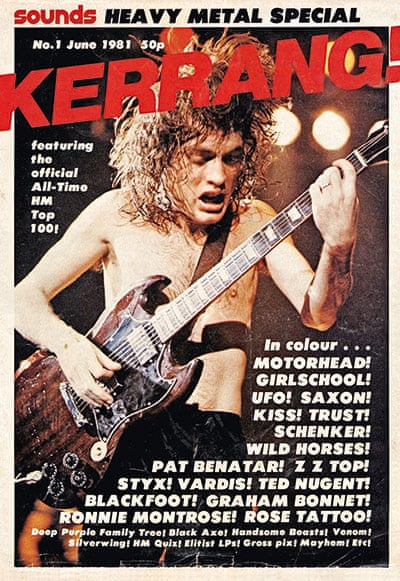
The first issue of Kerrang! magazine.
Social identity theory - tribes
Social identity theory can create different tribes because social identity is a person’s sense of who they are based on their group membership so people who like the same things, e.g. in fashion and music will get along better with each other and create different groups of people with similar interests.
Tuesday, 20 September 2016
Representation and Ideology
Representation and Ideology
Each genre has its own Ideology - a set of beliefsThe big dichotomy is between pop and rock
Ideology affects representation
Pop - conformity:
- Clean cut image - good looks key to success
- Songs about love - asexual, non-threatening
- Ability to play live is less important
- Conform to norms
- For kids
- Seen as ephemeral - here today and gone tomorrow
Rock/hip hop - rebellion:
- Can be scruffy or untidy - looks less important
- Songs about sex, anger, drugs
- Must play well live
- Non-conformist
- For Adults
- Genuine, authentic, for real
- 'Classic' - built to last
Musical genres and pop case study
Musical genres
Pop:
- Indie pop
- Dance pop
- Country pop
- Lounge music
- Pop rock
- Pop punk
- Experimental pop
- Traditional pop music
- New wave music
Rock:
- Adult Alternative Rock
- American Trad Rock
- Arena Rock
- Blues-Rock
- British Invasion
- Death Metal/Black Metal
- Glam Rock
- Hair Metal
- Hard Rock
- Metal
- Jam Bands
- Prog-Rock/Art Rock
- Psychedelic
- Rock & Roll
- Rockabilly
- Roots Rock
- Singer/Songwriter
- Southern Rock
- Surf
- Tex-Mex
Pop music background information
Pop music is a genre of popular music which originated in the 1950s, deriving from rock and roll. Although pop music is seen as just the singles charts, it is not the sum of all chart music. "Pop music" may be used to describe a distinct genre, aimed at a youth market, often characterized as a softer alternative to rock and roll. In the 2000s, three trends affected pop music: declining sales of CDs, online piracy of digital files of songs, and the growth of pop careers launched through televised talent shows such as Pop Idol in the UK and similar versions in various countries.
Some examples of pop music artists are; Justin Bieber, Drake, Adele, SIA, etc.
Tuesday, 6 September 2016


Subscribe to:
Posts (Atom)